

Every ranking of "the hardest language in the world" you have ever seen traces back to one source: the Foreign Service Institute, the school that trains US diplomats. For seventy years the FSI has been putting adults through intensive language courses and measuring exactly how many hours it takes them to reach professional proficiency. That data is the closest thing we have to an objective difficulty ranking, because it comes from the same learners, the same method, and the same finish line.
Here is what that ranking actually says, which languages sit at the top, and a twist most articles miss: the features that make a language hard for a human to learn are often the exact features that make it hard for a machine to translate.
How difficulty is actually measured
The FSI sorts languages into five categories by the number of class hours a native English speaker needs to reach "professional working proficiency." The scale is not about how the language sounds or how exotic it looks — it is purely about time-to-fluency for an English speaker.
| Category | Hours | Examples |
|---|---|---|
| I — closest to English | ~600–750 | Spanish, French, Italian, Dutch, Danish, Swedish |
| II | ~750 | German |
| III | ~900 | Indonesian, Swahili |
| IV | ~1,100 | Russian, Polish, Turkish, Hindi, Finnish, Vietnamese, Thai |
| V — exceptionally hard | ~2,200 | Mandarin, Cantonese, Japanese, Korean, Arabic |
The jump from Category IV to Category V is the one to notice. A Category V language takes roughly four times as long as Spanish. And Japanese is sometimes marked as even harder within its own category.
The five hardest, and what makes each one hard
1. Mandarin Chinese
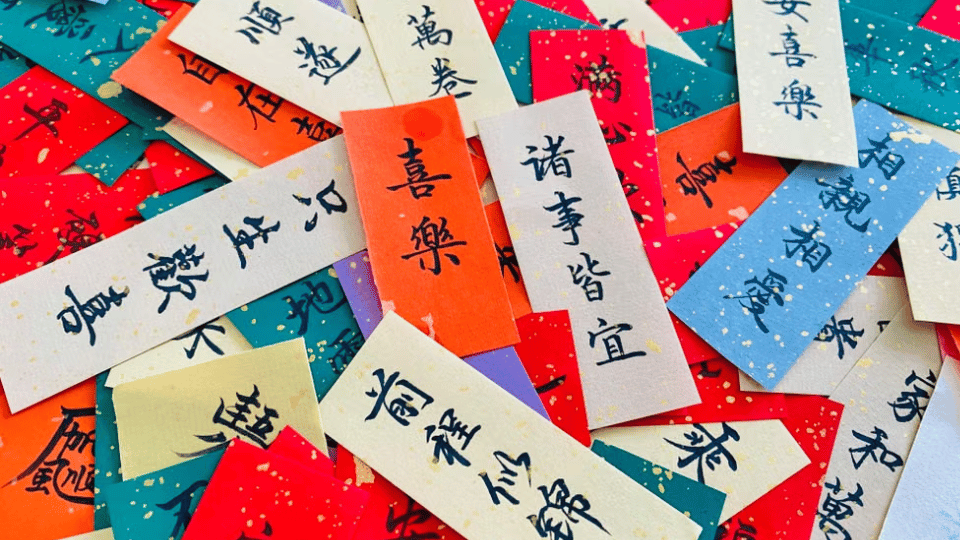
Two obstacles at once. First, it is tonal: the same syllable, ma, means "mother," "hemp," "horse," or "scold" depending on pitch. Second, there is no alphabet — literacy means memorising thousands of individual characters, and you cannot sound out a word you have never seen.
2. Arabic
The script runs right to left, most short vowels are not written, and letters change shape depending on their position in a word. On top of that, "Arabic" is really a family: the written standard differs sharply from the spoken dialects of Morocco, Egypt or the Gulf, so learning one does not guarantee you understand another.
3. Japanese
Three writing systems used simultaneously — hiragana, katakana and thousands of kanji borrowed from Chinese plus an elaborate system of politeness levels that changes verbs, nouns and pronouns based on who you are speaking to and about.
4. Korean
The alphabet, Hangul, is famously logical and can be learned in an afternoon, that part is easy. The difficulty is grammar: sentence structure is reversed relative to English (subject–object–verb), and a dense system of honorifics reshapes the whole sentence depending on social hierarchy.
5. Cantonese
Even harder than Mandarin on one axis: where Mandarin has four tones, Cantonese has six (some count nine). It is also primarily a spoken language with no fully standardised written form, which makes formal study unusually slippery.
The twist: hard to learn often means hard to translate
This is where a translation company sees something a language school doesn't. The features that cost human learners thousands of hours are the same ones that trip up Google Translate and DeepL — because they require context, and machines are weakest at context.
Tones and missing vowels create ambiguity a machine can't resolve
When Arabic omits short vowels, a single written form can be several different words; only meaning tells them apart. When Chinese packs four words into one sound, only the surrounding sentence disambiguates. A human translator reads the whole document to decide. Machine translation guesses from statistics, and on legal or medical text, a guess is a liability.
Honorifics carry meaning that English simply doesn't encode
Japanese and Korean grammar encodes the relationship between speaker and listener. Translate a Korean business email into English literally and you lose the register entirely; translate the other way and a machine has no way to know whether your recipient is a peer, a client or a superior. That decision is cultural, not grammatical, which is why it needs a person.
Word order forces a full rewrite, not a substitution
Subject–object–verb languages like Japanese, Korean and Turkish can't be translated word-by-word into English. The entire sentence has to be reassembled. Machine translation increasingly manages short sentences, but on long, clause-heavy legal sentences the reassembly is exactly where errors hide.
Rule of thumb: the higher a language sits on the FSI difficulty scale, the wider the quality gap between machine translation and a professional human translator — and the higher the stakes of getting it wrong.
So which is the single hardest?
By raw FSI hours, all Category V languages are tied at roughly 2,200. If forced to pick one, most linguists point to Mandarin or Arabic for the combination of an unfamiliar writing system and a feature English lacks entirely (tones for Mandarin, non-linear script and diglossia for Arabic). But "hardest" depends on your starting point: for a Korean speaker, Japanese is relatively easy, and English is the hard one.
Difficulty, in other words, is a distance measured from wherever you happen to start.
Why the hardest languages need a specialised translation company, not an app
For a Category I language on a casual text, a translation app is often good enough. For a Category IV or V language on a document that matters, it is a gamble and the reason is everything above. Tones, non-linear scripts, honorifics and reversed word order are precisely the features that professional human translation handles and machines approximate.
This is where it stops being trivia and starts costing money. A mistranslated clause in a legal contract, a dosage error in a medical document, or a garbled specification in a technical manual is not a typo it is liability. And when a document has to be accepted by an authority, you need certified translation or sworn translation, which a machine cannot provide at all.
That is the practical takeaway of the FSI scale: the harder the language, the more a specialised agency working with native-speaker translators outperforms automation, because the whole difficulty of the language is context, and context is exactly what a human reads and a machine guesses.