

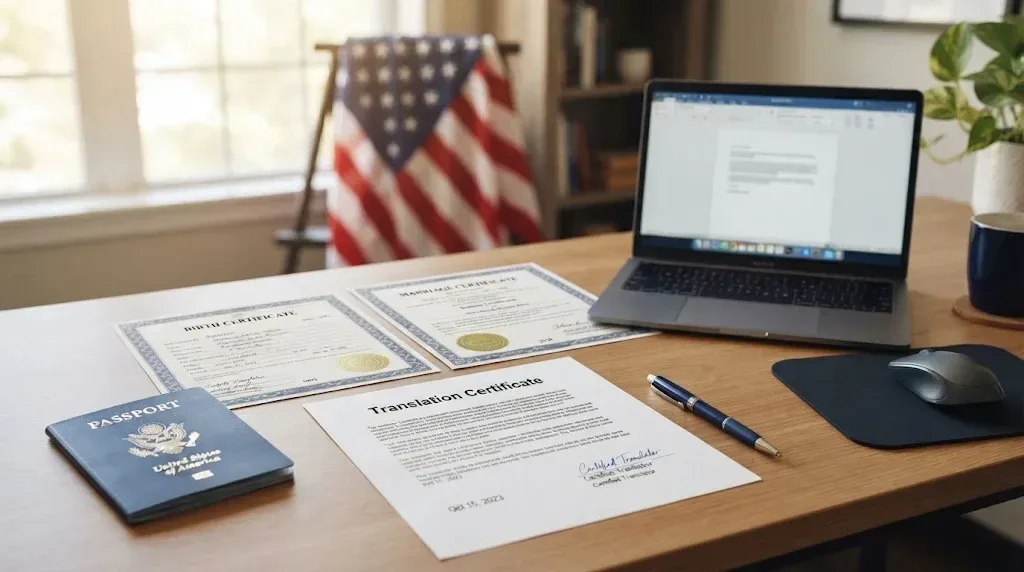
A green card file is a paper trail of your whole life. Birth certificates, marriage records, court documents, police certificates and school diplomas all land on the desk of a USCIS officer who reads English and nothing else. Every page written in another language needs a proper English version, and this is where many otherwise strong applications stall. Green card translation looks like a small administrative step, but it is one of the most common reasons a case is paused for a Request for Evidence.
What the law actually says about translations
The rule is short and strict. Under the USCIS checklist of required initial evidence for Form I-485, any document in a foreign language must be filed with a full English translation. The translator must certify that the translation is complete and accurate, and that they are competent to translate from the foreign language into English. The certification should carry the translator's name, signature, date and contact details.
Notice what is not on that list. USCIS does not ask for a notary stamp, a government license or a membership card from a translators' association. What it asks for is a complete translation and a signed statement of competence. A professional USCIS translation delivered with a Certificate of Translation Accuracy ticks every one of those boxes, and the copy of the original document must travel with it.
Which green card documents usually need translation
The exact list depends on your category, whether it is family based, employment based or a diversity visa. These are the documents that most often appear in a file.
| Document | Where it is used | Common trap |
|---|---|---|
| Birth certificate | Proof of identity and family relationship | Marginal notes and stamps left untranslated |
| Marriage certificate | Spouse based petitions | Maiden name spelled differently than in the passport |
| Divorce decree | Proving a prior marriage has ended | Missing the final judgment page |
| Police certificate | Admissibility and background review | Translating only the summary line |
| Diplomas and transcripts | Employment based categories | Grading scales left unexplained |
| Court and adoption records | Special family situations | Handwritten sections skipped |
If you are also dealing with criminal record paperwork, our guide to police clearance certificate translation explains the extra care these records need.
Five mistakes that trigger a Request for Evidence
A Request for Evidence does not mean refusal, but it does mean weeks of delay and a hard deadline. These are the errors we see most often.
- Partial translation. Stamps, seals, handwritten notes and the back of a page are part of the document. If it is printed on the page, it needs translating.
- Missing certification. A translation without the signed statement of accuracy is simply text. The statement is what makes it evidence.
- Inconsistent names. A name transliterated one way on the birth certificate and another way on the passport creates doubt about identity. Translators should follow the passport spelling.
- Date confusion. A date written 03/04/1990 means March 4 in the United States and 3 April in most of the world. A good translator writes the month out in words.
- No copy of the original. The translation must be filed together with a copy of the source document so the officer can match them.
Can you translate your own documents?
The regulation does not name a forbidden translator, so a bilingual applicant can technically certify their own work. In practice it is a gamble. An officer reading a translation signed by the applicant, or by a spouse or parent, may reasonably question its neutrality. An independent professional removes that doubt before it appears.
Why machine translation is not enough
Free online tools are fast, but they cannot sign a certification, they cannot be held accountable, and they regularly stumble on civil registry vocabulary. Terms such as legitimate child, registry office or decree absolute have no word for word equivalent. A human specialist chooses the term that US immigration practice recognizes. For anything that supports a green card, that judgment is the whole point of certified translation services.
Language matters as much as the document
Immigration cases come from every corner of the world, and each language brings its own traps. Cyrillic names need consistent transliteration, so a Russian translation should be handled by someone who knows the format of Soviet and post Soviet records. Latin American civil records often carry long compound surnames, which is why a dedicated Spanish translation services team matters. Applicants from Southeast Asia benefit from a Vietnamese translation specialist who understands name order. You can browse the full list of languages we support, more than 200 in total.
How the process works with PoliLingua
Our immigration document translation service is built around the way USCIS reads a file. Standard civil documents are usually delivered within 24 to 48 hours, pricing starts at $25 per page, and a rush option is available for an additional 20 percent. Every order returns a signed PDF with a Certificate of Translation Accuracy, and sworn or notarized versions can be added when another authority asks for them. Larger cases that mix several document types are covered by our broader professional translation services.
Filing a green card application soon? Send us your documents and get a clear quote with a delivery date, usually within hours. Our certified translations are accepted by USCIS, and every file comes with our accuracy guarantee.
Request a free quote or see how our immigration translation service works from start to finish.
The short version
Translate everything on the page, certify it with a signed statement, keep names and dates consistent, and file the translation with a copy of the original. Do that, and the translation stops being a risk and becomes a quiet strength of your application. Requirements can change, so always confirm the current rules on the official USCIS website before you submit.