

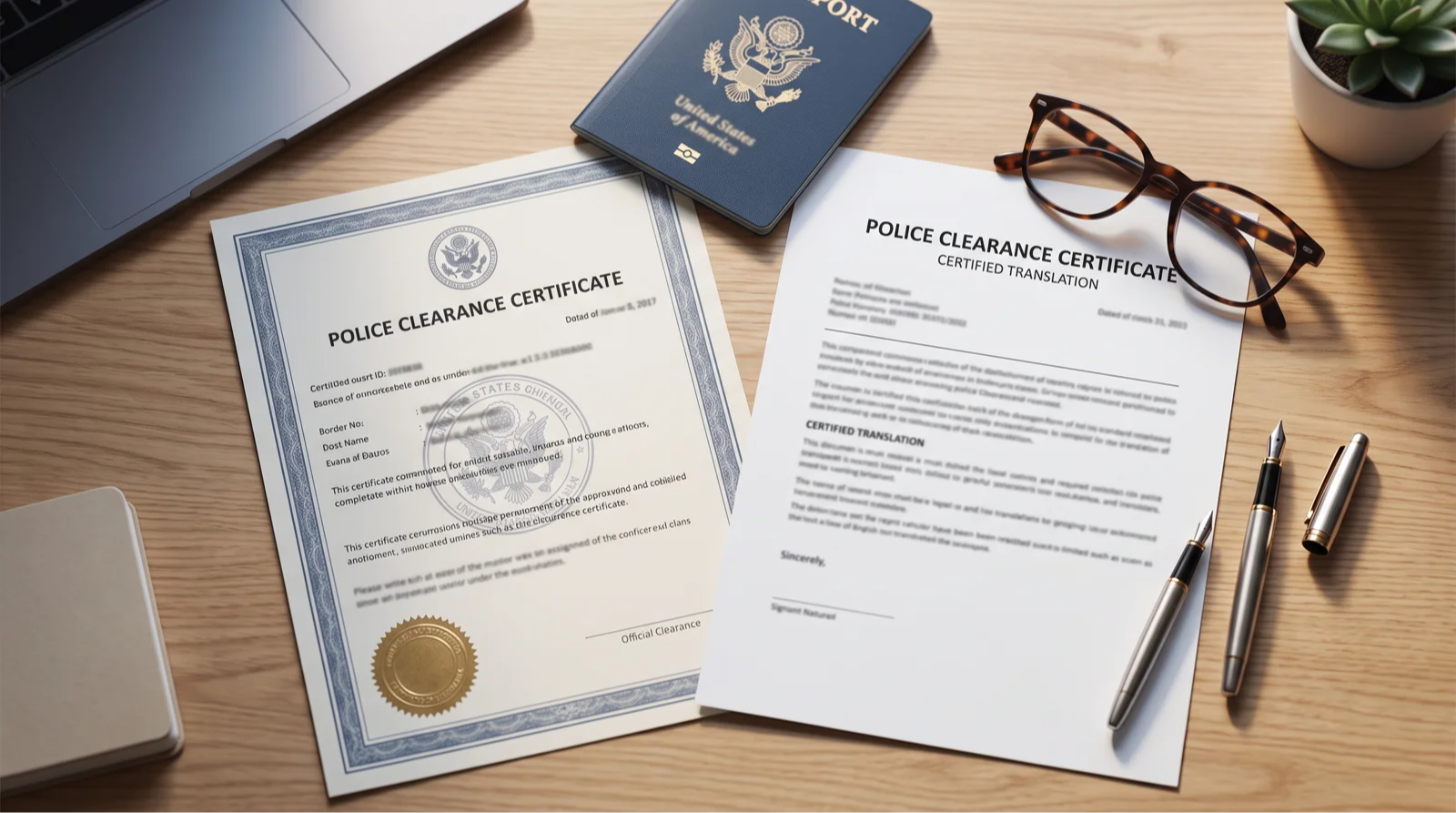
Of all the documents in an immigration file, the police clearance certificate is the one people think about least. Yet it is one of the most common reasons applications stall. Officers cannot assess a document they cannot read, and a police certificate written in Romanian, Arabic, Portuguese or Korean means nothing to a caseworker in Ottawa, Washington or Canberra until it has been translated properly.
This guide explains what a police clearance certificate translation involves, what immigration authorities expect, and the small mistakes that cause big delays.
What a Police Clearance Certificate Actually Is
A police clearance certificate (also called a police certificate, criminal record certificate, certificate of good conduct or background check) is an official document issued by a national or regional authority. It confirms whether a person has a criminal record in that country. Its name changes from place to place. In Germany it is the Führungszeugnis, in France the extrait de casier judiciaire, in Spain the certificado de antecedentes penales, in Brazil the atestado de antecedentes criminais, and in Moldova and Romania the cazier judiciar.
That variety is exactly why translation matters. The same legal concept is expressed through different institutions, different terminology and different formats. A translator who only knows the language, but not how criminal record systems work, can easily turn a precise legal statement into something vague or misleading.
Who Asks for a Translated Police Certificate
Most people need one when they apply for permanent residence, a long stay visa, citizenship, a work permit or a job that involves children, finance or security. Immigration programmes are the biggest driver. Canada, for example, requires a police certificate from each country where an applicant has spent six consecutive months or more in the last ten years, as described in the official IRCC police certificate requirements. If that certificate is not in English or French, a translation must be submitted with it.
Requirements by Destination at a Glance
| Destination | Accepted languages | What the translation needs |
|---|---|---|
| United States (USCIS) | English | Full translation plus a translator certification of competence and accuracy |
| Canada (IRCC) | English or French | Translation by a certified translator, or an affidavit from the translator if not certified |
| Australia (Home Affairs) | English | Translation by a NAATI accredited translator when lodged in Australia |
| United Kingdom (Home Office) | English or Welsh | Translator credentials, date, contact details and confirmation that it is accurate |
| EU member states | Official language of that state | Often a sworn translation, sometimes with an apostille on the original |
Why Machine Translation Is a Risky Shortcut
It is tempting to run a one page certificate through a free online tool. The problem is that police certificates are dense with legal terms that machines routinely get wrong. "Conviction," "charge," "caution," "spent conviction," "rehabilitated" and "no data recorded" have very specific meanings in each legal system. Swap one for another and an officer may believe you have a record you do not have, or think the document is incomplete.
There is also the matter of form. Immigration officers expect every element of the original to appear in the translation, including stamps, seals, signatures, reference numbers, issuing authority and any handwritten notes. Machine output ignores these. A professional translator marks them clearly, for example as [Stamp: Ministry of Justice] or [Signature illegible], so the officer can match the translation to the original line by line.
Finally, a machine cannot sign a certification. Almost every immigration authority wants a named, accountable person to confirm that the translation is complete and accurate. That is why applicants choose certified translation services rather than gambling on a document that could send the whole file back to the start of the queue.
Common Mistakes That Delay Applications
The most frequent problem is translating only part of the document. Applicants sometimes skip the back page, the footer or the security text because it looks like boilerplate. Officers want everything translated, and a partial translation can be treated as no translation at all.
The second problem is timing. Many authorities only accept police certificates issued within the last three to six months. If you wait weeks before ordering the translation, the certificate itself may expire while your file is still being prepared. Order the translation as soon as you receive the original.
Third, names and dates must match your passport exactly. A transliterated surname that differs by one letter from your other documents is enough to trigger a request for clarification. A good translator will ask you how your name appears in your passport before finalising the text.
Last, people often forget legalisation. Some countries require an apostille on the original certificate, and some want the translation itself sworn or notarised. Getting these steps in the wrong order can mean paying twice.
How to Order a Police Clearance Certificate Translation
Start by checking the exact translation rules for your destination and programme. Then send a clear colour scan of the full certificate, front and back, together with a copy of your passport so the translator can match names correctly. Tell the translator where the document will be submitted, because a translation for USCIS is formatted differently from one for a German Ausländerbehörde.
For applicants heading to the United States, it helps to choose a provider that already works with USCIS certified translation services every day and knows the certification wording officers expect. If your file includes other papers, such as birth or marriage certificates, translating everything together keeps terminology and name spellings consistent across the whole application.
Why Professional Translation Pays Off
A police certificate is a short document with a long shadow. It speaks directly to your character in the eyes of an immigration officer, and any ambiguity is resolved by asking you for more paperwork, which costs weeks. Paying a professional to translate one page correctly is a small price compared with a refused or delayed visa.
PoliLingua translates police clearance certificates and other official records from and into all major world languages, with certified translators who understand both the legal systems involved and the formatting rules of each immigration authority. Whether you need a single certificate for a work visa or a full set of document translation services for a family relocation, our team delivers accurate, certified translations that officers can accept the first time.