

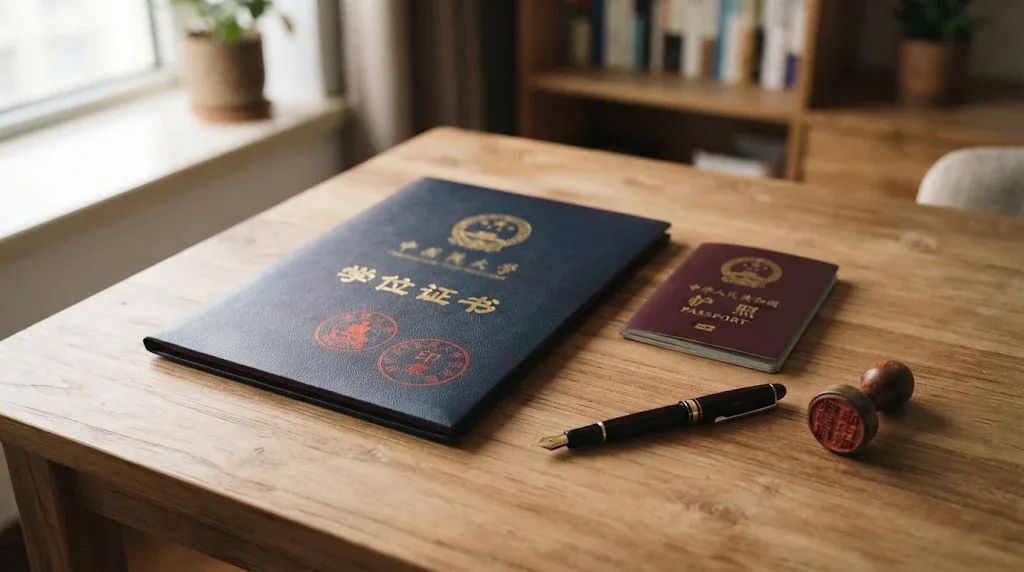
A Chinese degree certificate is one of the most requested documents in credential evaluation, university admission and work visa cases. It is also one of the easiest to get wrong. A diploma, a graduation certificate and a transcript are three different papers, each with its own title, and a translation that mixes them up can send an evaluator in the wrong direction. This guide explains what each document is, how Chinese diploma translation should be done and how to prepare a file that evaluators and admissions offices accept the first time.
Know the documents
Chinese higher education usually produces two separate certificates. The graduation certificate confirms that the student completed the program. The degree certificate confirms that a degree was awarded, such as bachelor or master. A transcript lists courses and grades. Many applicants send only one of them, and the receiving office then asks for the rest. It is better to prepare the full set from the start.
| Document | What it proves | Needs translation |
|---|---|---|
| Graduation certificate | Completion of the program and its level | Yes, with seals and numbers |
| Degree certificate | Award of the degree and the date | Yes, with the degree title exactly as issued |
| Academic transcript | Courses, credits and grades | Yes, including grading scale and notes |
| Online verification report | Authenticity of the records | Yes, if the receiving office needs it in English |
| Admission or enrollment letter | Study status | Yes, for visas and scholarships |
Need your Chinese diploma translated for evaluation? Send scans of your certificates and transcript and tell us where they will be used. You get a clear quote and a certified translation on time.
Verification reports often come first
Many universities now ask for an independent check of Chinese records before they review an application. The Comparative Education Service at the University of Toronto, for instance, lists on its document requirements page for China that applicants must supply verification reports, in English or Chinese, for the degree certificate, the graduation certificate and the academic records. The reports are issued through the official Chinese platform for higher education records, and they may need their own translation if they are only available in Chinese. Check what your destination requires before you order, so that no document is missing.
How a diploma should be translated
- Names. The holder's name follows the passport spelling, as explained in our article on Chinese name translation and pinyin.
- Institution. The university uses its official English name, and the Chinese name is kept in brackets when helpful.
- Degree and major. The title is translated literally and consistently, and abbreviations are explained once.
- Dates. Dates are converted from year, month, day to the format the agency expects, without changing the facts.
- Seals, signatures and numbers. Each seal and certificate number is described or copied, so the reader knows what appeared on the page.
- Grades. The translation keeps original scores and grading scales, and any conversion to another system is left to the evaluator.
Details that cause delays
- Different spellings across documents. A name that varies between the diploma, the transcript and the passport raises questions.
- Course titles translated differently. One course should have one English title everywhere.
- Missing back pages. Notes on the reverse of a transcript often explain grading rules.
- Poor scans. Seals and numbers must be readable.
- Old institution names. Universities merge and rename, so the translation should reflect the name on the date of issue.
Certification and evaluation services
Credential evaluators generally want a complete and accurate translation signed by a competent translator. Some also want the original or a copy of the verified record sent directly. We prepare translations for these purposes through our ENIC and ECCTIS certified translation service, and our official certified translation services cover other agencies. If the diploma supports a visa or residence application, our visa and immigration document translation team checks that it matches the rest of the file. Our overview of USCIS translation requirements explains what a certification should include.
Apostille and legalization
Some destinations ask for a diploma to be authenticated in China before translation. Since China joined the Apostille Convention in 2023, many authentications are simpler, as explained in our article on China apostille and document translation. Always confirm with the receiving office whether the apostille, the translation or both are needed, and in what order.
Simplified or traditional characters
Mainland diplomas are written in simplified characters, so our simplified Chinese translation team handles them. Taiwan and Hong Kong diplomas use traditional characters and a different style, and our traditional Chinese translation team takes them. Learn more in our guide to simplified and traditional Chinese.
Why professional translation matters for academic records
An academic file is often reviewed by people who do not read Chinese, and they rely entirely on the translation to understand what you studied and what you earned. A careless rendering of a degree title or a course name can lower the level an evaluator assigns, delay an admission decision or cause a work permit to be questioned. Free tools tend to translate seals as random words and to mangle institution names. A professional translator knows the conventions of Chinese certificates, keeps every element of the page visible in the English and signs a statement that makes the translation usable for official purposes. That small investment protects months of study and the cost of the application itself.
Preparation checklist
- Collect the degree certificate, graduation certificate and transcript.
- Scan every page, including the reverse, in color and at good resolution.
- Gather the passport page and any earlier spellings of your name.
- Ask the receiving office what format and certification it wants.
- Order all documents together, so names and terms stay consistent.
Frequently asked questions
Do I need to translate the graduation certificate and the degree certificate? Usually yes. They prove different facts, and evaluators often ask for both.
Can you convert my grades to a GPA? We translate the grades as issued. Conversion is normally done by the evaluation service.
How long does it take? Short certificates are often ready within a day or two. Transcripts take longer.
A diploma translation that evaluators accept
PoliLingua translates Chinese academic documents with attention to names, titles and seals, and every file is reviewed before it is certified.
Ready to translate your Chinese diploma? Upload your documents and we will confirm the price and the delivery time the same day.