

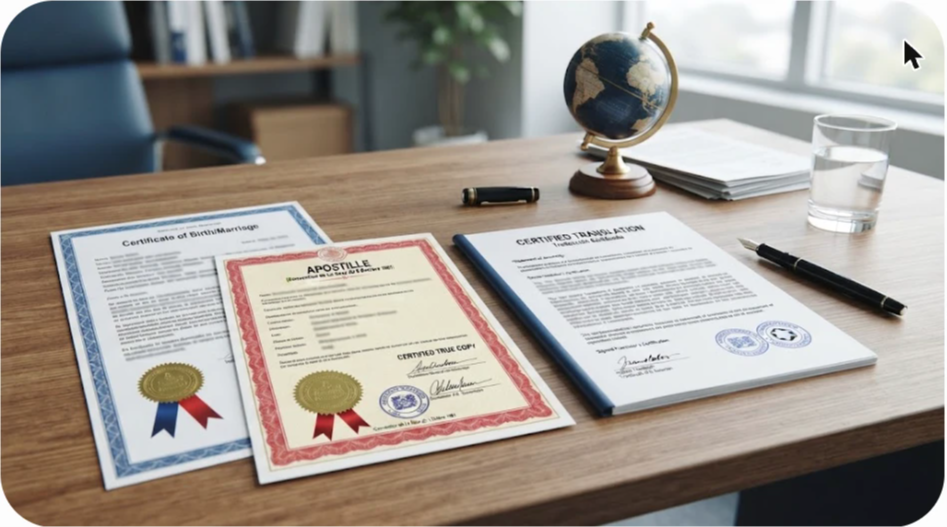
Every year, thousands of visa applications, university enrollments, and international marriages stall at the same point. Someone submits a document that's translated but not apostilled, or apostilled but not translated. The two processes solve completely different problems, and confusing them is one of the most common (and expensive) mistakes people make when sending paperwork abroad.
Here's what each one actually does, when you need one, the other, or both, and how to avoid a rejected submission.
What an Apostille Actually Certifies
An apostille is a certificate issued by a designated authority in the country where a document originated, often a Secretary of State's office, a foreign affairs ministry, or a court. It confirms that the signature, seal, or stamp on a public document (a birth certificate, diploma, or court order, for example) is genuine. It says nothing about the document's content, and nothing about any translation attached to it.
Apostilles exist because of the 1961 Hague Apostille Convention, which lets more than 120 member countries accept each other's public documents without further legalization by an embassy. If both the issuing country and the destination country are members, an apostille is usually all that's needed to prove the document itself is authentic. If either country isn't a member, you're looking at full consular legalization instead, a longer, multi-step process.
What a Certified Translation Actually Certifies
A certified document translation service provides a different kind of guarantee. It's a signed statement from the translator or translation company attesting that the translated text is a complete and accurate rendering of the original document. It says nothing about whether the original document's signatures are genuine; that's the apostille's job.
In some countries, this needs to go a step further into a sworn translation, produced by a translator who has been officially authorized by a court or government body to translate legal documents. Sworn translations typically carry more legal weight than a standard certified translation, and many government agencies in civil-law countries will only accept documents from a sworn translator. Germany is a good example: applicants sending records abroad often need a german document translation service that specifically works with court-authorized translators, not just any bilingual professional.
So Which One Do You Actually Need?
It depends entirely on what you're submitting the document for and to whom. The table below covers common scenarios:
| Situation | Certified translation | Apostille |
|---|---|---|
| Foreign visa or residency permit | Almost always required | Depends on destination country's rules |
| Foreign university enrollment | Usually required for transcripts/diplomas | Often required for degree verification, less often for basic admissions |
| Registering a foreign marriage or divorce | Required, often sworn | Usually required on the original |
| International adoption or custody cases | Required, usually sworn | Required on the original |
| Business contracts and corporate filings | Required for incorporation documents | Depends on the destination registry |
When in doubt, check the specific consulate, university, or agency's checklist rather than assuming your case matches someone else's.
The Order Matters
One detail that trips people up: in most jurisdictions, the apostille needs to be affixed to the original document (or a certified copy of it) before translation, and the translator then translates the apostille certificate itself along with the rest of the document. Getting this backward, translating first, then trying to apostille a translation that has no independent standing, is a common reason submissions bounce back. If you're not sure which order your destination country expects, confirm with the receiving institution before starting either process.
What Happens If You Get It Wrong
The practical cost of mixing these up isn't abstract. A missing apostille on an otherwise perfectly translated diploma can delay a university enrollment by weeks while the original document gets sent back for authentication. A certified translation without the required sworn-translator credential can get an entire visa application rejected outright in countries that are strict about who's allowed to translate legal paperwork. Apostille processing times also vary widely by issuing authority, sometimes days, sometimes over a month, so discovering you need one after your translation is already done can blow through a filing deadline.
Getting Both Done Efficiently
The most reliable path is to confirm the exact requirement with the receiving authority first: an embassy, university, court, or government office, since requirements genuinely vary by country and even by specific agency. Once you know whether you need an apostille, a certified translation, a sworn translation, or some combination, working with a translation provider that understands the legal distinctions (and that can flag when a sworn translator is required rather than a general certified one) saves a second round-trip.
Apostilles and certified translations aren't competing options. They're two separate checks that, together, tell a foreign authority both "this document is real" and "this document says what you think it says." Understanding which one your paperwork needs, and in what order, is the difference between a smooth submission and a folder that gets mailed back to you.