

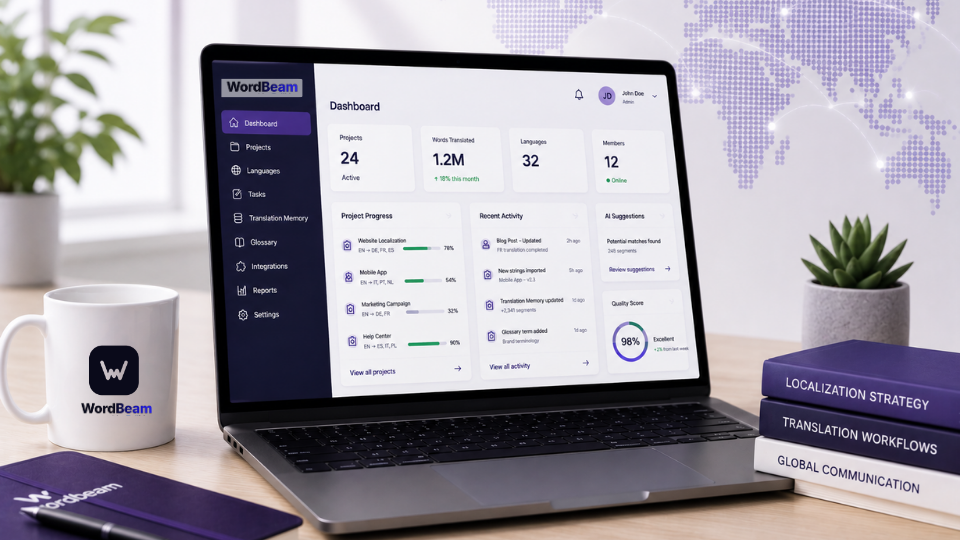
Every company that grows beyond its home market eventually runs into the same wall: translation stops being a task and becomes a bottleneck. Spreadsheets multiply, files get lost between departments, and no one is quite sure which version of a product description is the final one. This is the exact problem WordBeam was built to solve.
WordBeam is a new AI-powered translation management system (TMS), developed with the localization expertise of PoliLingua, a company that has spent over a decade helping businesses communicate across languages. Rather than treating translation as a series of one-off projects, WordBeam turns it into a connected, automated workflow that product teams, marketers, and localization managers can actually control.
What Makes a Translation Management System Different
A translation management system is not the same as a translation tool. A simple tool converts one piece of text into another language. A true TMS manages the entire lifecycle of that content: who translates it, how it's reviewed, where it's stored, and how it stays updated when the source text changes.
| Traditional Workflow | WordBeam Translation Management System |
|---|---|
| Files emailed between teams and vendors | Centralized platform with real-time collaboration |
| Manual tracking of translation versions | Automated version control and translation memory |
| Inconsistent terminology across languages | Shared glossaries and style guides enforced automatically |
| Delayed updates when source content changes | AI-flagged content changes trigger instant re-translation tasks |
| Limited visibility into project status | Live dashboards with deadlines, costs, and progress |
For companies managing five, ten, or fifty languages at once, that difference is not cosmetic. It is the line between a localization program that scales and one that quietly drains budget and time.
How WordBeam Uses AI Without Losing the Human Touch
WordBeam's AI does the repetitive work so human linguists can focus on what machines still can't do well: nuance, tone, and cultural adaptation. The system pre-translates content using neural machine translation, applies the client's own translation memory to keep phrasing consistent, and routes anything sensitive or brand-critical to a professional translator for review.
This hybrid model, AI speed paired with human judgment, is also the foundation of how PoliLingua has always worked with certified and professional translators across more than 100 languages. WordBeam simply gives that expertise a faster, more transparent engine to run on.
| Feature | What It Does For You |
|---|---|
| AI pre-translation | Cuts first-draft turnaround from days to minutes |
| Translation memory | Reuses previously approved translations to reduce cost |
| Terminology management | Keeps brand and technical terms consistent everywhere |
| Workflow automation | Automatically assigns tasks based on content type and deadline |
| API and CMS integrations | Syncs directly with websites, apps, and content platforms |
| Real-time analytics | Shows exactly where budget and time are going |
Who WordBeam Is Built For
WordBeam is designed for the teams that feel localization pain first: product managers launching in new markets, marketing teams localizing campaigns on tight deadlines, and localization managers who are tired of chasing translation status across five different tools. It works equally well for a startup translating its app into three languages and an enterprise managing continuous content updates across thirty.
Because it plugs into existing content systems rather than replacing them, teams don't need to overhaul their tech stack to adopt it. Content flows in, gets translated and reviewed inside WordBeam, and flows back out, updated, consistent, and ready to publish.
Why PoliLingua Built It
PoliLingua has translated everything from legal contracts to marketing campaigns for clients around the world, and one pattern kept repeating: the technology available to manage that work hadn't kept pace with how fast content needs to move today. WordBeam is PoliLingua's answer, a translation management system that combines enterprise-grade automation with the quality control that comes from decades of professional translation experience across more than 100 languages.
Security and compliance were part of the design brief from day one. Content stored inside WordBeam is encrypted in transit and at rest, access is role-based, and every change is logged, which matters as much for a legal team translating contracts as it does for a SaaS company localizing its product under a strict release schedule.
Getting Started
Adopting a new platform can feel like a project in itself, so WordBeam was built to onboard quickly. Most teams connect their first content source, whether that's a website, an app repository, or a document library, within a day, and existing translation memories or glossaries can be imported rather than rebuilt from scratch. From there, WordBeam's AI handles the first pass, PoliLingua's linguists handle quality assurance where it's needed, and the client keeps full visibility over cost, timeline, and status at every step.
Common questions we hear from teams evaluating a translation management system for the first time include how pricing scales with volume, whether existing vendors can still be used inside the platform, and how quickly a pilot project can go live. The short answer to all three: WordBeam is built to be flexible enough to fit around a team's existing process rather than force a rebuild.
For businesses evaluating how to scale localization without scaling headcount or chaos, WordBeam offers a practical starting point: one platform, one source of truth, and a workflow that gets faster the more it's used.
Learn more about WordBeam at wordbeam.net, or talk to PoliLingua about integrating it into your current translation workflow.