

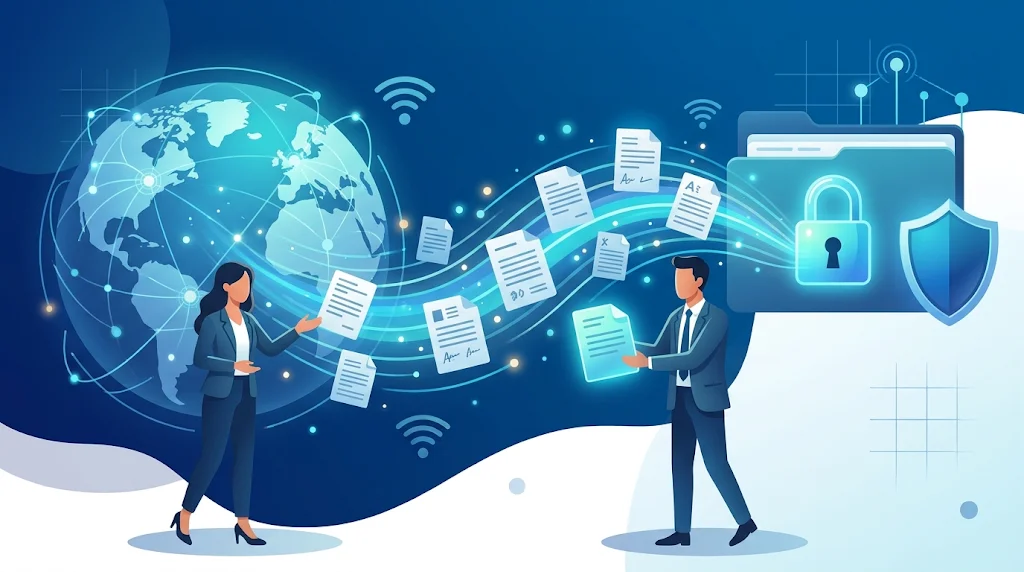
Business communication today is varied and global. Customers, partners and employees work in different languages, and company documents have to be translated to keep things running. Translating product descriptions and documents and supporting customers in several languages is routine work.
That work raises a security question. When a confidential document passes through a translator, an online platform and cloud-based tools, each step is a point where data can be exposed.
A single text may contain client details, sales figures, business plans or personal information. If that data reaches the wrong people, the result can be lost revenue, a damaged brand and legal trouble. Protecting confidential data takes more than accurate translation. It requires a secure working environment, a transparent process and clear responsibility for the data throughout multilingual communication.
Understand What Makes Business Information Sensitive
Business documents carry different levels of sensitivity, and they should be treated differently when they are shared with a translation agency or uploaded to an online environment.
Marketing brochures and other material meant for the public can go through standard translation channels. Employment contracts, legal papers, health records and accounting sheets must be kept strictly confidential and stored securely.
Before handing a document to a translation service provider or a cloud platform, a business should identify what confidential data it contains. Names that identify a person, bank account numbers, unreleased business ideas and customer names all need particular care.
The company should also decide who needs access. A translator working on a product manual needs the product descriptions, not customer databases or internal financial reports. Limiting access keeps down the number of people and systems that could expose confidential information.
These points become critical when a project spans several languages, involves many stakeholders and relies on people working remotely or from different locations.
Use Translation Tools That Have Good Privacy Policies
Online translation platforms save time, but anyone using them professionally needs to know how each one treats submitted content. Depending on the provider and the plan, a text or document may be stored on a cloud server, kept for a period of time or made available to the provider's staff under certain conditions.
Before using an app for secure document translation, read its privacy policy and check what the provider does with your data: how long it is kept, how access is controlled and whether submitted text can be used to improve AI models. Professional plans often include contractual protections that free consumer versions do not.
Companies using AI tools should also make sure administrators can limit data sharing and manage access centrally. Staff should not assume that a document is private just because they uploaded it through a familiar system.
PoliLingua's guide to secure translation services shows how confidential data can be safeguarded at every stage of translation. Comparing approaches like these helps companies choose the right provider while protecting their customers' data.
Safeguards for Remote Teams and Translators
Translation teams often include remote staff and freelance translators, along with project managers and clients in different locations. This flexible setup is efficient, and it is also risky, because sensitive information is accessed from many devices and networks.
Companies should apply the same procedures everywhere for managing files, assigning access rights, handling credentials and reaching internal systems. Multi-factor authentication, strong passwords, automatic software updates and encryption all reduce the most common threats.
Organizations can also review practical remote cybersecurity practices when developing policies for distributed teams. These measures are especially useful for employees who access translation platforms, cloud files or internal documents from outside the office.
Every document exchange should come with clear rules: where the file is delivered, who reviews it, what it is for, where it is stored and when it is deleted. Employees and freelancers should know these rules before they receive access to sensitive files.
Protect Data on Public Networks
People often use travel time to review documents or talk to foreign clients. Public Wi-Fi in hotels, airports and cafés makes that convenient, but there is rarely much information about how the network is run.
A virtual private network (VPN) encrypts the traffic between a user's device and the VPN server. A trustworthy VPN is a good way to protect data on an unfamiliar network.
A VPN does not guard against every threat. A deceptive website does not become safe because the user reaches it through a VPN.
Organizations should have employees follow agreed network security measures and, where applicable, use only company-approved VPN services. Devices also need up-to-date operating systems, screen locks and endpoint protection.
VPNOverview's privacy guides are a useful resource for anyone who wants to learn more about internet privacy. They cover VPN technology, online security and related privacy topics, and they help employees make better decisions when handling sensitive business information remotely.
Lower the Risk of Phishing and Unauthorized Access
When an employee sends sensitive data to the wrong party, the information is already gone and technical safeguards no longer help.
Phishers often pose as a genuine client or vendor and email an employee to request documents or login credentials. Any doubt should be cleared up through a different, trusted channel.
Employees should confirm requests for confidential files by phone or in person. They should avoid opening suspicious files and report unusual login activity straight away.
Companies can reinforce this with training in phishing detection. Softer Insight's resource on team protection against social engineering explains how misleading messages exploit trust and time pressure.
Improve Your Cybersecurity Posture with Layered Defense
Layered defense works like the layers of a knight's armour: a single attack is unlikely to get through all of them.
The foundation is perimeter defense, such as firewalls and email filtering. A second layer is antivirus software that scans incoming files for malicious code. A third is web filtering, which matters most where employees use the internet freely.
Cybercriminals keep getting better at social engineering scams that look legitimate. Every employee should be trained on phishing and on the importance of multi-factor authentication.
As further measures, an organization can add an identity and access management system or a network intrusion detection system (NIDS).
Incident reporting should be open and simple. Employees need to know whom to contact if they share a file by mistake, click a suspicious link or notice that an account may have been compromised.
Establish Clear Responsibilities for Data Protection
Keeping multilingual communication secure is a team effort involving the business, translators, technology suppliers and individual staff. The company and its provider should set out confidentiality requirements, limits on data use, expected security levels and incident reporting methods in a written agreement.
In some situations, organizations need to review their data processing agreements and the privacy laws that apply to their activities.
International firms may have to decide where data is stored and whether cross-border data flows are allowed, and work out which regulations apply when their documents are transferred.
A regular review should identify and remove outdated permissions, unused services, unnecessary software integrations and inefficient processes. If a breach occurs, a documented response plan allows the problem to be isolated, investigated and resolved quickly, and the affected parties to be notified.
Security should be part of a project team's daily routine, not a separate task that gets attention only after a failure.
Designing a Safer Multilingual Communication Strategy
Data confidentiality does not mean cutting off communication or refusing to work across time zones. It means recognizing the risks and applying procedures that match how sensitive the data is.
Companies should assess the translation platforms they use, limit access to confidential data to authorized people, secure remote access and train employees to handle suspicious requests. They should also review their data storage and retention policies and make sure external providers are bound by the same confidentiality requirements.
With the right mix of technology, repeatable workflows and human oversight, enterprises can communicate across languages while minimizing the risk of leaking confidential data.
As multilingual business operations expand, companies that make data protection a core part of their communication approach will be better placed to keep customer trust and handle personal data lawfully.