

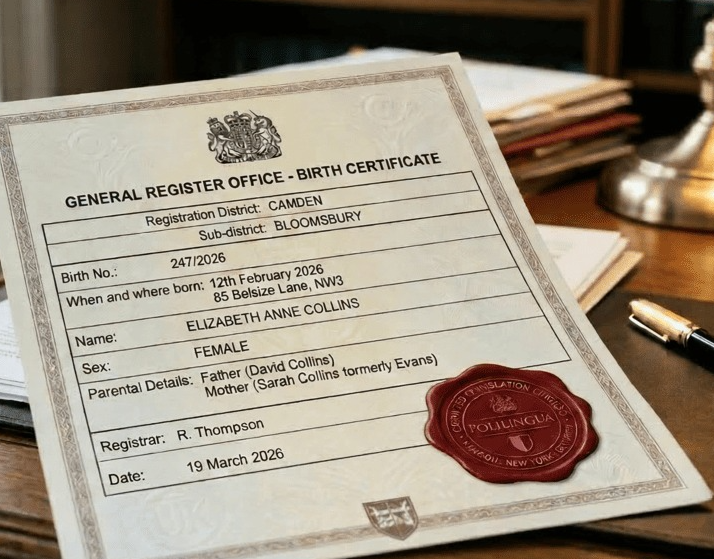
A birth certificate is one of the most frequently requested documents in any immigration file, and it is also one of the easiest to get rejected. Immigration officers, university registrars and civil registries all handle birth certificates constantly, but each of them expects the translated version to meet a specific standard. Getting that standard wrong, even on a document as short as a birth certificate, is enough to stall a visa petition or a citizenship application for weeks, which is why a proper birth certificate translation is worth setting up correctly from the first submission rather than fixing after a rejection notice.
What a Certified Birth Certificate Translation Actually Means
A certified translation is not simply an accurate rendering of the original text. It is the accurate rendering paired with a signed statement from the translator or translation company attesting that the translation is complete and correct to the best of their knowledge, along with their name, signature, date and contact details, typically on company letterhead. Most government agencies, including USCIS, do not require the translator to hold a specific license or sworn status, but they do require this certification statement to accompany the translated document every time.
When You Actually Need One
| Situation | Why a certified translation is required |
|---|---|
| USCIS petitions (I-130, I-485, N-400) | Federal regulation requires a full English translation and certification for every foreign-language document filed. |
| Immigrant and non-immigrant visa applications | Consular officers require English translations of any birth certificate submitted as supporting evidence. |
| School or university enrollment abroad | Registrars generally require the original plus a certified translation to confirm identity and age. |
| Marriage abroad or to a foreign national | Civil registries need translated birth records to verify identity and eligibility to marry. |
| Dual citizenship or passport renewal | Foreign consulates process citizenship claims using certified translations of birth records. |
| Domestic and international adoption | Courts and adoption agencies require certified translations as part of the case file. |
What a Compliant Translation Must Include
Every word on the original document has to appear in the translation, including stamps, seals, registrar signatures and any handwritten marginal notes. A translation that quietly leaves out a seal because it seemed decorative, or paraphrases a registrar's note instead of translating it, is not a complete translation and can be rejected on that basis alone. Where a mark is genuinely illegible, the translator should say so directly rather than guessing or omitting it.
Common Mistakes That Get Applications Rejected
The most common error is having a bilingual relative translate the document. USCIS does not technically bar a family member from translating, but almost every rejection tied to this comes from the missing or informal certification statement, not from the language quality itself, since relatives rarely know the exact wording an agency expects. A close second is confusing notarization with certification. A notary confirms the identity of the person signing a document, not the accuracy of the translation, so a notarized translation without a proper certification statement still falls short. Free machine translation tools cause a third category of problems, since they produce no certification at all and routinely mistranslate names, dates or the fine print on official seals.
Certified Translation Is Not the Same as an Apostille
These two requirements are often confused, but they solve different problems. A certified translation makes a foreign-language document readable and usable to an English-speaking agency, while an apostille authenticates the original document itself for use in another country under the Hague Convention. Many filings need both, and PoliLingua's guide on apostille versus certified translation walks through which one applies to a given document.
Turnaround Time and What Affects the Price
Because a birth certificate is short and highly standardized, it is one of the fastest documents to translate and certify, and pricing is usually simpler too. Providers typically charge per document or per page rather than per word for a record this size, with the final price shaped mainly by the language pair, how quickly the certificate is needed, and whether the original has unusual handwriting, damage or extra annotations that take longer to render accurately. Rush service for a same-day or next-day certified translation is common and worth asking about directly if a filing deadline is close, since a birth certificate rarely needs the multi-day turnaround that a longer legal contract or a full academic transcript would.
Does a birth certificate translation need to be notarized?
Not for USCIS purposes. A signed certification statement satisfies the federal requirement under 8 CFR 103.2, though some courts, state agencies or foreign consulates ask for notarization in addition. Confirm with the receiving agency before submitting.
Can I translate my own birth certificate?
Regulations do not explicitly forbid it, but in practice almost every agency rejects a translation completed by the applicant or a family member, since the certifier cannot be considered impartial. Using an independent, professional translator avoids the issue entirely.
How long does a certified birth certificate translation take?
A birth certificate is short, so most providers return a certified translation within one to two business days, with rush turnaround typically available for time-sensitive filings.
PoliLingua's certified birth certificate translation service follows this exact standard on every order, so the certification statement, formatting and completeness are handled correctly the first time, whether the document is headed to USCIS, a university, or a foreign consulate.