

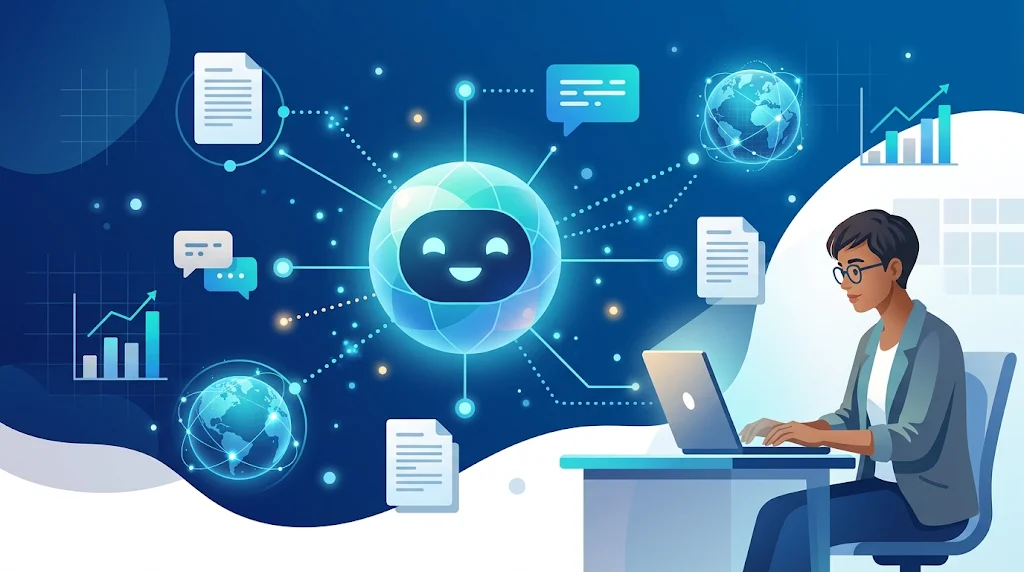
Artificial intelligence is changing how companies operate, serve customers and handle data. Traditional automation follows fixed rules. AI agents go further: they can read instructions, work with other tools and adjust what they do to fit the situation in front of them. That makes AI agents for business a practical way to remove repetitive work without relying on people for every step.
AI agents are already part of many digital processes, from customer support to content management. How well they work depends on a few things: solid system integration, data protection and people staying involved in decisions.
Understanding AI Agents in Business Automation
AI agents are software systems built to reach a specific goal. They can interpret what a person wants, gather data from different systems, carry out actions in third-party software and complete a whole business workflow from start to finish.
Take customer support. An agent can sort an incoming message, find the relevant documents in a knowledge base, draft a reply and ask a person to review it. The employee handles only the final check, while the agent does the rest in a single pass.
Rule-based automation, including many low-code and no-code platforms, runs pre-programmed scripts. It suits narrow tasks that need little judgment. AI agents can adapt to different versions of a customer request and decide which action fits best.
Their capabilities are impressive, but AI business automation still needs clear permissions, reliable data and the right supervision to work well.
How AI Agents Streamline Work Processes
A major advantage of AI workflow automation is that agents connect tasks an employee would otherwise do by switching between apps. A company may run separate systems for customer communication, project management, documents and reporting. When these are properly aligned, an agent can move data between them and remove unnecessary manual steps.
Marketing teams can use AI agents to compile research, draft content proposals, summarize performance reports and flag follow-up tasks. Support teams can classify queries and suggest matching answers. Operations teams can monitor routine procedures and highlight anything unusual.
These gains matter most to smaller companies with limited staff. Businesses can explore suitable SaaS products for small businesses to find software that supports their existing operations before adding more advanced AI automation. Choosing tools that work together is usually more practical than adding several disconnected platforms.
AI Agents and Multilingual Business Communication
When a company starts operating in foreign markets, managing communication in several languages gets complicated quickly. Product descriptions, customer service messages, guides and marketing copy all need translation.
AI agents can help with parts of this process: routing content for translation, spotting missing information, checking terminology against approved resources and organizing review tasks. For example:
- An agent can detect that a new product page needs localization and prepare the files.
- An agent can send translated content to the right reviewer before anything is published.
PoliLingua's description of an AI-powered translation management system shows how translation workflows can become more connected and structured. AI can reduce the administrative work, but language specialists still have the main role in reviewing meaning, cultural context, tone and accuracy.
The aim is not to hand language decisions to machines. Companies can use AI for routine coordination so that specialists are free for the work that needs professional judgment.
Choosing the Right Infrastructure for AI Agents
AI automation depends on the infrastructure it runs on. A hosted platform suits some agents. Others need a separate environment where the team controls software, dependencies, integrations and access permissions.
The right setup depends on the workload. A small agent that handles a few requests can run on a managed service. An agent that runs continuously and works across several applications may need more control over its runtime environment, storage and network configuration.
Comparing the best VPS for OpenClaw hosting providers can help a team weigh the available hosting options. The decision should rest on memory, processing power, operating system compatibility, reliability and security measures as well as price.
Businesses also need to plan how they will maintain the environment after deployment. Software updates, backups, monitoring and user access management all contribute to a reliable automated system.
Security and Access Control in Automated Workflows
AI agents can create security problems because they interact with confidential documents, business accounts, APIs and internal tools. An agent with too many permissions, combined with a bad instruction or a compromised integration, can leak information or trigger an action nobody intended.
A good starting point is to give agents access only to what their assigned tasks require. Operations such as money transfers, deleting important documents or sharing confidential files should need approval from a person.
When rolling out AI tools across distributed teams, companies should also revisit their remote cybersecurity practices. Secure password management, strong authentication, software updates and clear access policies reduce risk across connected systems.
Agents also need monitoring. A business should know which systems an agent accessed and when, what it did, and where a person stepped in. Logs make it possible to trace the cause of an error and to improve the agent's workflow over time.
Keeping Human Oversight in Place
AI agents can take a wrong step, misread an instruction or return incomplete results. Their output can also be inaccurate when the data is out of date or the sources conflict. Full automation works in some areas, but it is not the best approach for every business process.
It helps to assign work by risk. Low-risk tasks can run quickly with light supervision. Documents with legal implications, major financial commitments, confidential information or public communications should go to experienced people for review.
Before giving an agent autonomy, organizations should set clear limits: permitted tools, spending budgets, data restrictions, escalation policies and the situations where a person must step in.
Regular testing can uncover flaws before they affect customers or the company. Teams should check that the agent completes the task, that it produces correct results consistently and that it handles unexpected situations sensibly.
Measuring the Business Value of AI Automation
Adopting AI agents does not guarantee better performance. Organizations need to measure how the new technology compares with their existing processes.
Useful indicators include task time, error rates, volume of work handled, customer satisfaction and the amount of manual work remaining. Companies also need to count subscription, hosting, maintenance and training costs.
A small pilot is a sensible start. A team might automate one repetitive task or improve how customer requests are sorted, then move on to larger and more complex workflows. This shows tangible benefits and exposes problems early.
The effect on employees matters too. Automation works best when people understand the system, can trust its output and can report issues easily.
The Future of AI Agents in Digital Workflows
As software platforms get better at communicating with each other, AI agents will become more deeply integrated across systems. Instead of isolated assistants that each handle one job, future solutions are likely to be connected systems that manage customer support, marketing, software development and internal operations together.
Wider adoption will depend on reliability, user privacy, cost and clear accountability. Companies will need to decide which tasks benefit from greater autonomy and where human expertise should stay in the lead.
Organizations that begin with projects whose outcomes they understand, on a secure and trustworthy foundation, will adapt more easily and deploy AI agents responsibly.
Summary
AI agents are transforming business automation by planning and coordinating work as well as handling repetitive tasks. They can be applied from day-to-day administration to multilingual communication and highly technical digital operations.
Deployment needs the right software, a suitable runtime environment, strict data protection and continuous human monitoring. Companies that start with simple use cases gradually discover where AI agents add the most value.