

Artificial intelligence has transformed many industries, and language translation is no exception. With the rise of automated translation tools and AI-powered language models, people can now translate text instantly with just a few clicks. Businesses, students, and travelers all benefit from the convenience and speed of these tools.
However, despite these technological advancements, professional human translation continues to play a critical role in global communication. Language is more than just words—it carries cultural meaning, tone, emotion, and context. While AI can process language quickly, it often struggles to capture these deeper nuances that experienced human translators understand naturally.
In many professional fields, the accuracy and cultural sensitivity of translation are essential. This is why professional translators remain an important part of the modern communication landscape, even in the age of advanced artificial intelligence.
Understanding the Limits of AI Translation
AI translation systems work by analyzing large datasets of multilingual text and identifying patterns between languages. This allows them to provide fast translations for common phrases and general communication.
For basic tasks such as translating simple messages or understanding the general meaning of foreign text, AI tools can be extremely helpful. They are especially useful for travelers, casual conversations, or quick research.
However, AI systems often struggle with more complex language situations. Idioms, humor, cultural references, and context-specific meanings can easily be misunderstood by automated tools. A phrase that makes perfect sense in one language might lose its meaning or even become confusing when translated literally.
Professional translators, on the other hand, understand the cultural and contextual elements of language. They know when a direct translation works and when a message needs to be adapted to communicate the intended meaning effectively.
The Importance of Cultural Context
Language is deeply connected to culture. Words, expressions, and communication styles often reflect the traditions, values, and social norms of a particular region.
For example, marketing campaigns, business presentations, and literary works require careful adaptation when translated for international audiences. A slogan that resonates with customers in one country might sound awkward or inappropriate in another.
Professional translators consider these cultural differences when translating content. They ensure that the message maintains its original tone and intention while also being culturally appropriate for the target audience.
This level of cultural awareness is something that AI tools still struggle to replicate consistently.
Accuracy in Legal and Medical Fields
In fields such as law and medicine, translation accuracy is absolutely critical. A single mistake in a legal document, medical report, or technical manual can lead to serious misunderstandings or even legal consequences.
Professional translators working in these industries often specialize in specific terminology and standards. They carefully review documents to ensure that every detail is translated correctly.
AI translation tools may provide a rough understanding of complex texts, but they cannot guarantee the precision required for professional documentation. Human expertise and verification are essential when dealing with sensitive or high-stakes information.
Preserving Tone and Emotional Impact
Another important advantage of professional translation is the ability to preserve tone and emotional impact. Language is not only about conveying information—it is also about expressing feelings, personality, and style.
Creative content such as novels, speeches, films, and poetry requires a deep understanding of storytelling and emotion. A literal translation might technically convey the words, but it may fail to capture the author’s voice or the emotional tone of the original work.
Professional translators approach language as both a technical skill and an art form. They adjust phrasing, rhythm, and cultural references to ensure that the translated version feels natural and engaging for readers.
Just like artists combine images and ideas through a collage design to create a meaningful visual story, skilled translators blend linguistic knowledge and cultural understanding to recreate the original message in another language.
The Value of Human Judgment
AI tools rely on algorithms and training data, but they lack human judgment and intuition. When translating complex material, professionals often need to interpret ambiguous sentences, clarify meanings, or consult with clients to ensure accuracy.
Human translators can ask questions, evaluate context, and make informed decisions about how a message should be communicated. This flexibility is essential when working with nuanced or specialized content.
Additionally, professional translators often work as part of a larger editing and proofreading process. Multiple experts may review a document to ensure quality, consistency, and clarity before it is finalized.
This collaborative process adds a level of reliability that automated systems alone cannot provide.
The Future: Collaboration Between AI and Human Translators
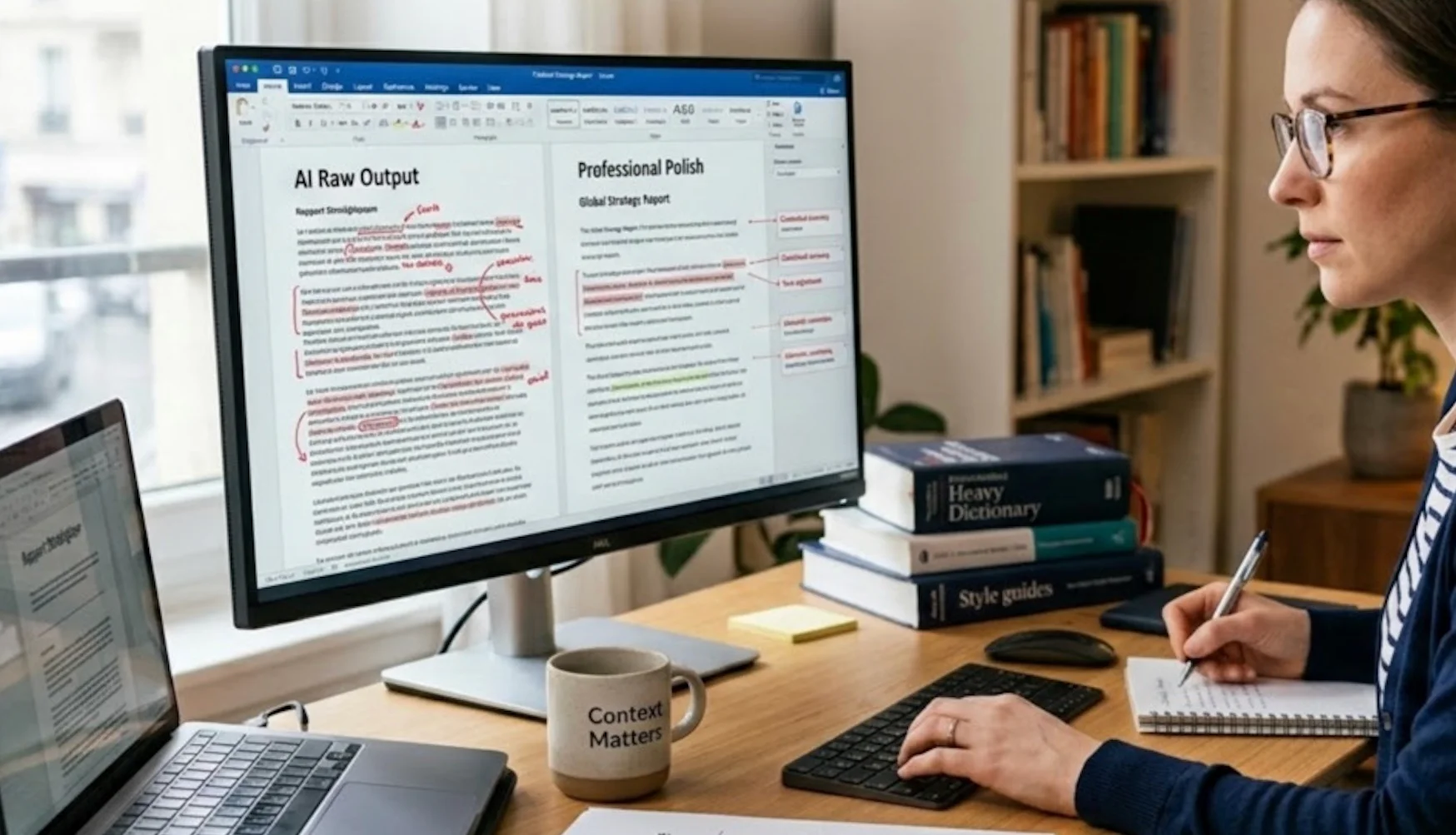
Rather than replacing professional translators, AI technology is increasingly becoming a helpful tool that supports their work. Many translators use AI-powered tools to speed up certain tasks, such as generating initial drafts or managing terminology databases.
This collaboration allows professionals to focus on refining language, correcting errors, and adapting content for cultural relevance. AI handles repetitive tasks, while human expertise ensures the final translation meets high-quality standards.
As technology continues to evolve, this partnership between humans and machines will likely become the standard approach in the translation industry.
Conclusion
Artificial intelligence has greatly improved the accessibility and speed of language translation. However, language is complex and deeply connected to culture, emotion, and context—elements that automated systems still struggle to fully understand.
Professional translators bring human insight, cultural awareness, and linguistic expertise that ensure messages are communicated accurately and effectively. In fields such as business, law, healthcare, and creative media, this level of precision remains essential.
In the age of AI, professional translation is not becoming obsolete. Instead, it is evolving, combining advanced technology with human knowledge to create communication that is both efficient and meaningful in a globally connected world.