

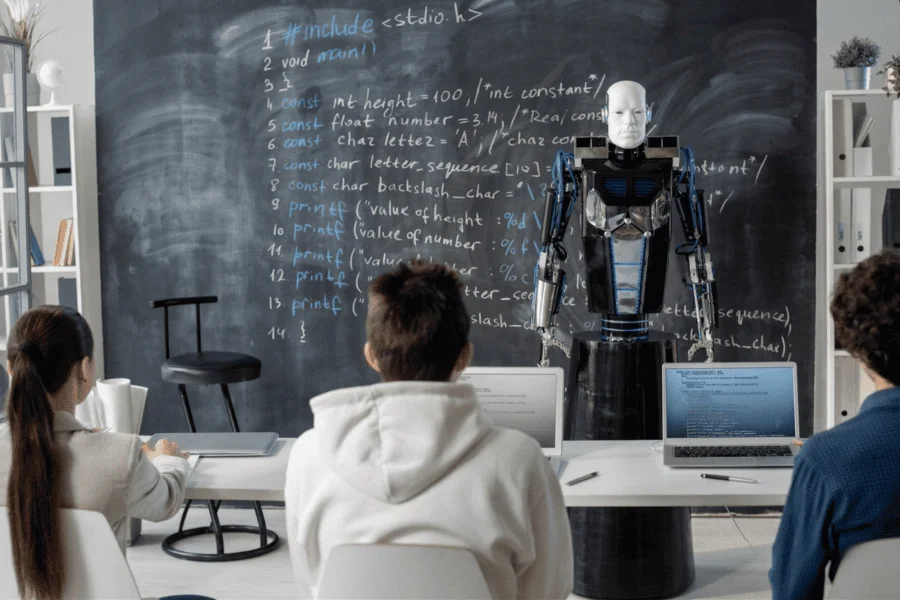
Learning new languages is a massive commitment that challenges you in so many ways that it’s not surprising that you might want to quit at some point. For instance, it’s difficult to feel embarrassed every time you pronounce the words wrong and make grammatical mistakes, especially in front of a tutor who knows all the rules. That’s one of the reasons why more and more people prefer using AI tools that correct their pitch accent in real-time without any judgment. Moreover, AI avatars allow them to polish their language skills from anywhere and at any time.
Does this mean that we’re witnessing the end of the human educator? While the efficiency of AI tutors for language learning is undeniable, the transition from learning a language to communicating as a human shows us a complex divide between digital precision and emotional intelligence.
What AI Tutors Can Actually Do Today
The first thing to understand is that today's AI tutors look nothing like the clunky grammar drills of the past. They are sophisticated systems capable of doing things that would have seemed remarkable even a decade ago. To be fair, though, it was also impossible to imagine back then that we were going to use AI technology to generate all kinds of content in different languages and then run it through tools like an AI fixer to make it more human-like. But here we are.
As to the platforms like Duolingo, Speak, and Khanmigo, they use machine learning to build personalized paths that evolve with each user. If you keep stumbling on the subjunctive in French, the system notices it and quietly gives you more relevant exercises to practice. And if you're racing ahead on vocabulary, it accelerates. On top of that, an AI tutor doesn't take holidays and doesn't have fifteen other students waiting. It is there whenever you feel like learning new words or testing your conversation skills.
Pronunciation feedback has become particularly impressive. Tools powered by automatic speech recognition can now detect subtle phonetic errors and explain them clearly. It’s also quite helpful that you can track progress using dashboards that show you exactly where you stand. Even though it’s a powerful toolkit, tools are only part of the story.
The Rise of the Machine and Where AI Excels
No matter how strongly we may oppose AI playing a major role in language learning nowadays, we can’t underestimate the importance of the structural problems it solves. A single platform can help fifty million learners all at once and do it at a fraction of the cost of human instruction. For learners in rural or underserved regions where qualified teachers are expensive, this is a crucial advantage.
Language learning is uniquely exposing. You are, by definition, performing in your weakest register, making mistakes in front of other people. This is one more problem that AI in education solves, as it removes the social stakes entirely. You can mispronounce bonjour forty times in a row, and the machine will simply try again with you. This creates a psychological safe haven for learners to move through their silent period with confidence.
What AI Still Gets Wrong
Unfortunately for many of us, you can’t simply download a new language into your brain because it is a cultural human practice. This is where the debate of AI vs human teachers language learning becomes most nuanced.
Idiom and cultural nuance
A skilled teacher goes beyond giving you a simple explanation of an idiom and might tell you where they were when they first heard it used in earnest and which contexts it would seem perfectly natural in. A human tutor sitting in front of you reads your face when you don't follow and looks for a different angle to help you. In a word, they draw on years of lived cultural experience to make language feel like something you inhabit rather than something you memorize.
Your tutor can explain why a phrase might be grammatically perfect but socially inappropriate in a specific neighborhood of Mexico City or a boardroom in Tokyo. AI cannot do this (at least not yet) and not in the way that counts. While an AI can define a word, a human teacher can describe the feeling behind it. Large language models can define idioms and provide examples, but the transmission of cultural intuition is a completely different thing.
Motivation is a significant gap
Many language learners often hit a plateau, where progress slows and the temptation to quit creeps in. A good human teacher sees this coming and asks the right question or sets a challenge that reignites something. Therefore, this emotional attunement is one of the most underrated skills in teaching, and it is not something AI currently models in any meaningful way.
The Human Teacher's Evolving Role
At this point in AI technology development, a hybrid evolution of language learning seems to be one of the effective approaches. The next question we need to answer is what should human teachers do when AI takes over the majority of routine processes.
There is a version of language education that is all about repetition and grammar exercises. This is work that AI does efficiently and cheaply. If teachers no longer need to do it, they can focus on their unique abilities, such as facilitating real conversation, transmitting cultural knowledge, and coaching students through the emotional difficulties of long-term skill acquisition.
Moreover, the blended classroom model is already emerging in language schools and universities. Teachers now use AI-generated analytics to see exactly where a class is struggling before they even step into the room. This allows them to tailor their high-value face-to-face time to the specific needs of their students. At the same time, students work through AI-assisted exercises independently and spend time with teachers on discussion, debate, and cultural exploration.
Ethical Issues and the Digital Divide
As we embrace these tools, we must also confront the corresponding ethical challenges, including algorithmic bias, for example. If an AI is trained primarily on standard accents, it risks marginalizing regional dialects and, as a result, flattening the richness of a language.
There is also the looming threat of a new digital divide. We face a future where high-quality human instruction becomes a premium product for the wealthy, while the rest of the world can rely on automated-only education. Ensuring that the human element of learning remains accessible to all is perhaps the greatest social challenge of the upcoming years.
Evolution over Replacement
It’s impossible to ignore the significant achievements of AI tutors, such as lowering the barrier of anxiety and creating genuinely personalized learning experiences. But they are not teachers. They don’t know their students and don’t care whether you keep going. They cannot tell, from the look on your face, that you need encouragement more than correction right now. Therefore, the framing of AI versus human teachers doesn’t seem to be relevant because the real language learning still requires a human being somewhere in the loop.